Debt Avalanche vs. Debt Snowball: Which Pays Off Credit Cards Faster?
We ran the numbers on $10,000 of credit card debt. See how the avalanche and snowball methods compare on time, interest and motivation.
How to use a 0% balance transfer card to pay off debt interest-free: fees, promo periods, traps to avoid and a worked example with $5,000.

If you’re paying high interest on a credit card, a balance transfer card can give you breathing room: it lets you move that debt to a new card that charges no interest for several months. Used well, it can save you hundreds or thousands of dollars. Used poorly, it just delays the problem.
It means moving the debt from one card (or several) to a new card, usually with a 0% introductory APR for a promotional period. That period typically lasts 12 to 21 months, depending on the offer and your credit.
During the promo, every dollar you pay goes straight to the balance instead of to interest.
There’s almost always a balance transfer fee, usually 3% to 5% of the amount you move. On $5,000, that’s $150 to $250, added to your balance.
Even so, it’s usually far cheaper than continuing to pay 20%+ interest.
Say you owe $5,000 on a card at 24% APR and can pay $286.11 a month.
Option 1: stay with your current card
Option 2: move it to a card with 0% for 18 months and a 3% fee
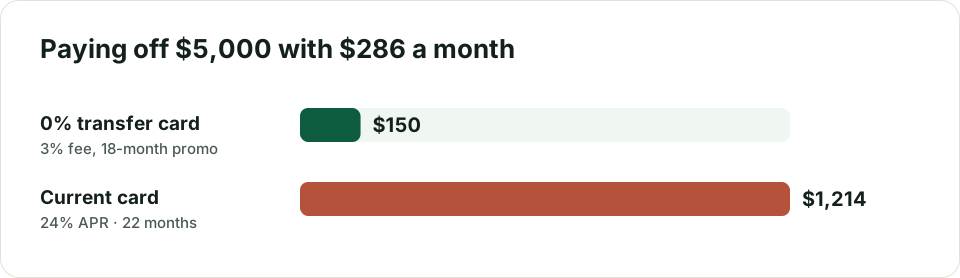
You save over $1,000 and get out of debt 4 months sooner.
A little at first: applying creates a hard inquiry, and a new account lowers the average age of your history. But over time it usually helps, because you pay down debt faster and your credit utilization falls. To understand how scores work, read how to build credit in the U.S.
You still have options:
Can I transfer a balance to another card from the same bank? Usually not. Most issuers only accept balances from other banks’ cards.
How much can I transfer? It depends on the credit limit you’re approved for on the new card — and the fee counts toward that limit.
Are there balance transfer cards with no fee? A few, though they’re less common and sometimes have shorter promos. Compare the total cost: a 3% fee with 21 months at 0% can beat a no-fee card with only 12 months.
This article is for educational purposes only and is not personalized financial advice. Card terms change; always review each offer’s terms. Read our Disclaimer.
We ran the numbers on $10,000 of credit card debt. See how the avalanche and snowball methods compare on time, interest and motivation.
What cryptocurrency is, how to buy it more safely in the U.S., Canada or the UK, how much to invest, how crypto is taxed and how to avoid scams.